Interaction Between Mechanical Load and Amino Acid Availability
Synergistic effects on muscle protein synthesis and muscle preservation
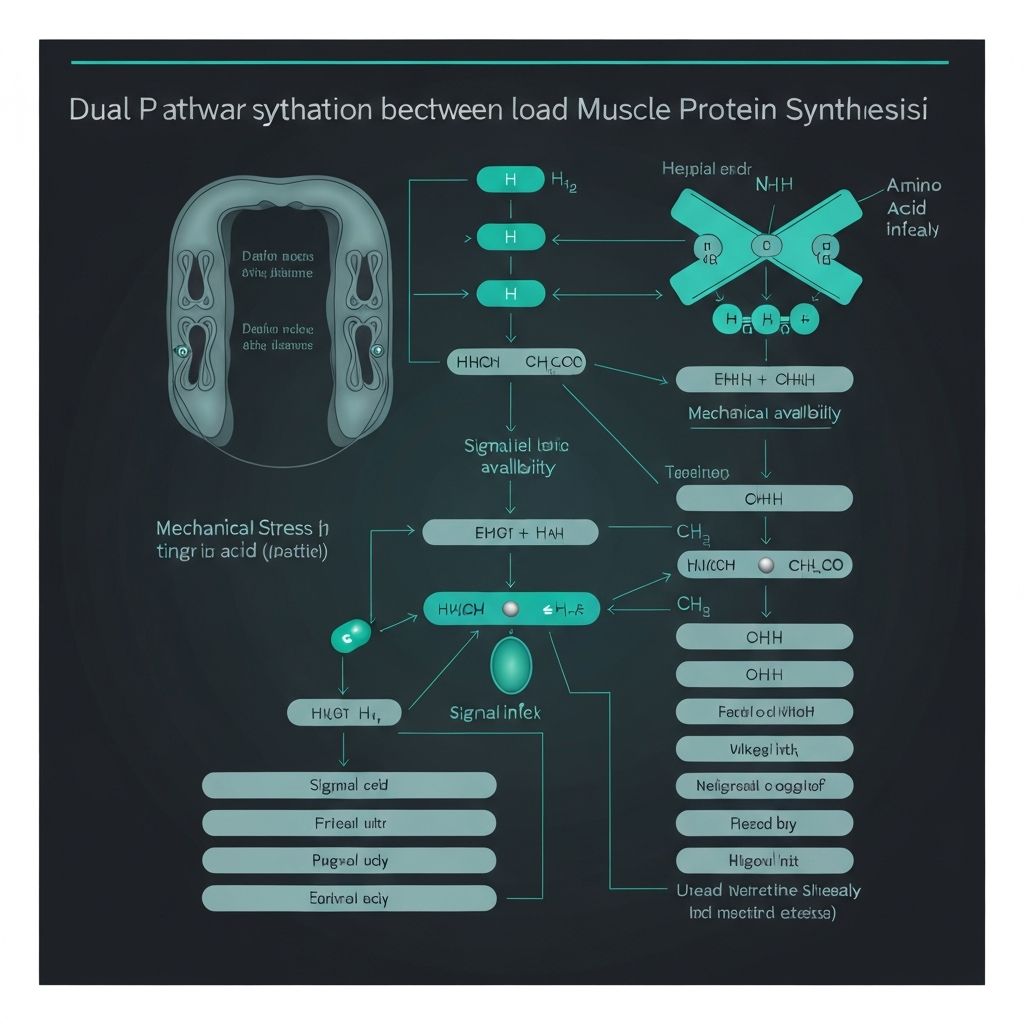
Synergistic effects on muscle protein synthesis and muscle preservation
Mechanical loading and amino acid availability represent two independent but complementary anabolic stimuli. Both inputs ultimately converge on the mTORC1 pathway, the master regulator of protein synthesis and cell growth. This convergence is critical to understanding muscle preservation during energy restriction.
Mechanotransduction (the conversion of mechanical force into biochemical signals) activates mTORC1 primarily through Akt-mediated inhibition of TSC2, which normally suppresses mTORC1 activity. Amino acids, particularly leucine, activate mTORC1 through a distinct mechanism involving the GATOR1/GATOR2 complex and the Rag GTPases.
The key insight is that both signals are required but are independent. Neither mechanical load nor amino acids alone fully restore anabolic capacity during energy deficit; however, their combination produces a synergistic (greater-than-additive) effect.
One mechanism underlying the synergistic interaction is that mechanical loading increases the sensitivity of muscle to amino acid signals. This is observed both acutely (within minutes to hours of resistance exercise) and chronically (in response to repeated training).
Acutely, resistance training primes mTORC1 signalling through mechanotransduction. When amino acids are subsequently provided, the already-elevated Akt and TSC2 inhibition means that mTORC1 remains in a highly activated state, producing a more robust MPS response than would occur with amino acids alone in untrained muscle.
Chronically, regular resistance training reduces the threshold for amino acid-stimulated mTORC1 activation and MPS. This is partly mediated through increased expression of amino acid sensing machinery (e.g., SLAC1, LAT proteins) and partly through enhanced insulin sensitivity, which amplifies Akt-mediated mTORC1 signalling in response to amino acids.
This explains why protein intake requirements are often expressed as relative to training status: untrained individuals may require higher total protein intake to achieve adequate MPS, whilst resistance-trained individuals achieve similar MPS responses at lower protein intakes due to enhanced sensitivity.
From a different angle, adequate amino acid provision allows the anabolic response initiated by mechanical loading to be sustained and efficiently translated into protein synthesis.
Resistance exercise depletes certain intracellular amino acid pools, particularly branched-chain amino acids, and upregulates amino acid uptake transporters. In the absence of sufficient amino acid provision (dietary or from protein breakdown), these pools remain depleted, limiting the rate of protein synthesis despite elevated mTORC1 signalling.
Conversely, when amino acids are abundantly available, they serve as substrates for the upregulated translation machinery activated by mechanical loading, allowing full expression of the synthetic capacity created by the mechanical stimulus.
Additionally, amino acid availability supports the synthesis of ribosomal proteins and other components of the translation apparatus itself, which requires several days of adequate protein intake to expand. This chronic adaptation enhances the total synthetic capacity of the muscle.
During energy restriction, both mechanical load and amino acid availability are challenged. Energy deficit reduces circulating amino acids (due to limited dietary intake) and reduces the systemic anabolic hormone environment (insulin, IGF-1). Additionally, the catabolic signals from energy deficit (AMPK activation, elevated cortisol) work against anabolism.
The protective effect of resistance training combined with adequate protein intake during energy restriction exemplifies the principle of convergent signalling:
Research quantifying the combined effect demonstrates a synergistic (non-additive) benefit: the preservation of muscle mass with combined resistance + adequate protein is greater than the sum of the individual effects of resistance training or protein intake alone.
The interaction between mechanical load and amino acids implies that there is a minimum effective dose of each needed for optimal protection. Studies examining "dose-response" relationships during energy restriction suggest:
These doses represent population averages; individual responses vary considerably based on genetics, training experience, age, and baseline body composition.