Resistance Training Effects on Myofibrillar Protein Synthesis
Mechanical loading and protein synthesis rates during energy restriction
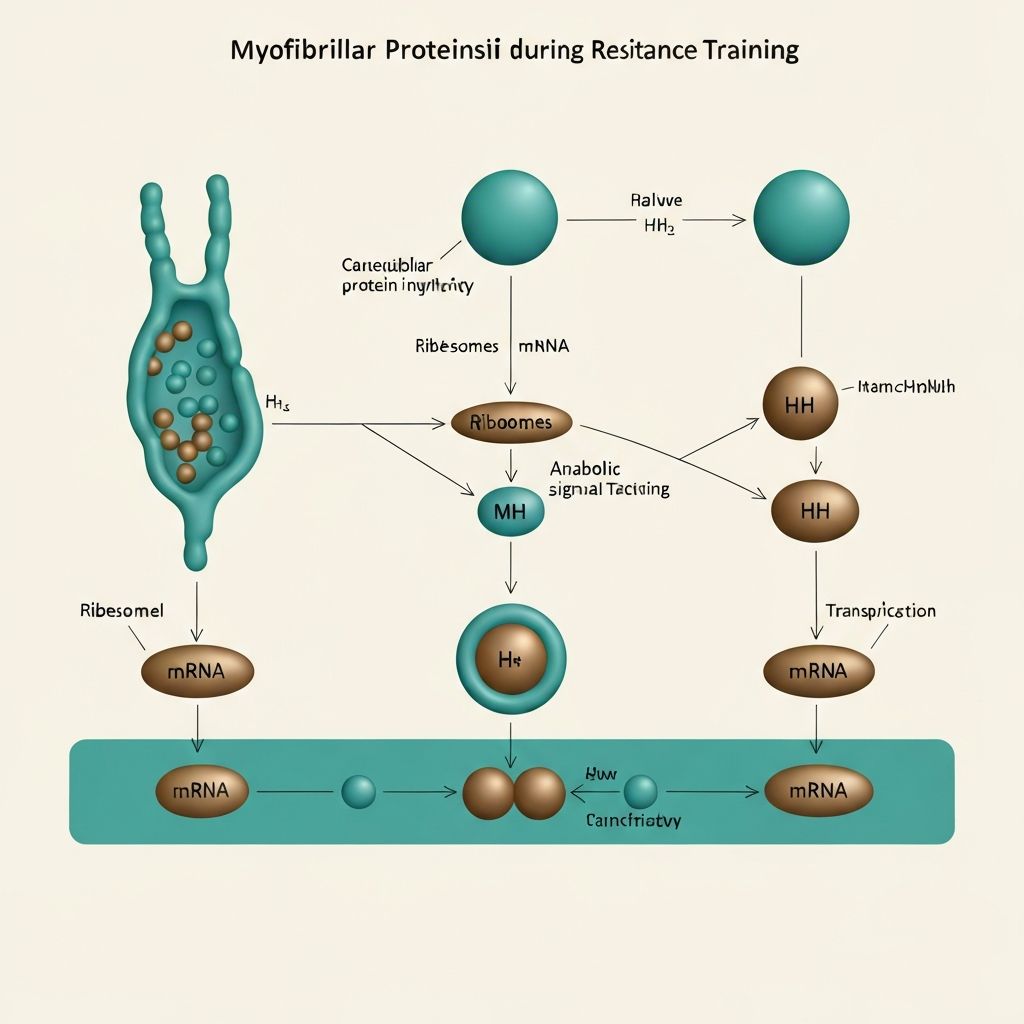
Mechanical loading and protein synthesis rates during energy restriction
Myofibrillar protein synthesis (MPS) refers specifically to the rate of synthesis of contractile proteins—myosin heavy chain, actin, tropomyosin, and other sarcomeric components. MPS is distinct from total muscle protein synthesis, which also includes sarcoplasmic proteins (enzymes, regulatory proteins) and structural proteins.
In vivo MPS is typically measured using stable isotope tracers, most commonly deuterated leucine (²H-leucine) or L-[ring-¹³C₆]-phenylalanine. Muscle biopsy samples are obtained, proteins extracted, and the incorporation of the labelled amino acid into myofibrillar proteins is quantified using mass spectrometry. This provides a measure of the rate of myofibrillar protein synthesis over the tracer incorporation period.
The postabsorptive (fasted) MPS rate at rest is relatively low, approximately 0.02–0.04% per hour. During energy deficit, this rate declines further. However, resistance exercise markedly elevates MPS, and this elevation persists for several hours post-exercise.
A single bout of resistance exercise acutely increases MPS rates by approximately 2- to 3-fold above resting levels in the subsequent hours. This elevation is mediated primarily by mTORC1 pathway activation through mechanotransduction mechanisms described previously.
The magnitude of the MPS response to resistance training depends on several factors:
The mechanism involves rapid (within minutes) phosphorylation of mTORC1 and downstream effectors (S6K1, 4E-BP1), which enhance the efficiency and rate of translation initiation and elongation. This increase in ribosomal activity directly translates to elevated amino acid incorporation into myofibrillar proteins.
A critical observation from acute metabolic studies is that energy restriction blunts the MPS response to resistance exercise compared to weight-stable or energy-surplus conditions. This phenomenon is termed anabolic resistance.
In weight-stable conditions, a single bout of resistance exercise may stimulate MPS to ~0.06–0.08% per hour. During energy deficit, the absolute stimulation is reduced, often to ~0.04–0.06% per hour. This reduction occurs despite similar mechanical stimulus and is attributed to the systemic catabolic environment: lower circulating insulin, lower amino acid availability, and elevated AMPK signalling all attenuate the anabolic response.
However, the impairment is partial, not complete. Resistance training still produces a 2- to 3-fold elevation of MPS above the depressed baseline, meaning that mechanical loading partially overcomes anabolic resistance. This is why the combination of resistance training and energy deficit still results in substantially better muscle retention than energy deficit alone.
The MPS response to resistance exercise is highly dependent on amino acid availability, particularly branched-chain amino acids (BCAAs) and leucine. Leucine acts as both a substrate for protein synthesis and as a potent activator of mTORC1.
Studies comparing MPS responses with and without amino acid provision show:
During energy restriction, protein intake becomes crucial for maintaining MPS sensitivity to resistance exercise. Sufficient protein intake (approximately 1.6–2.2 g/kg body weight daily) preserves amino acid availability and supports continued elevation of MPS post-exercise, even under caloric deficit.
The synergistic effect of mechanical loading and amino acid availability reflects the fact that both inputs converge on mTORC1: mechanical loading activates mTORC1 through mechanotransduction, and leucine/amino acids activate mTORC1 through the TOR complex. Their combined presence produces multiplicative enhancement of mTORC1 signalling and downstream MPS elevation.
The chronic effect of repeated resistance training sessions is hypertrophy (muscle mass gain) under anabolic conditions and attenuation of atrophy under catabolic conditions. This occurs because the repeated elevation of MPS from training sessions, if it exceeds the rate of protein degradation, results in net protein accretion.
During energy deficit:
Prospective studies measuring muscle protein balance (MPS minus protein degradation rate) demonstrate that resistance-trained individuals maintain closer to zero balance (or small positive balance) during energy deficit, whilst untrained individuals show strongly negative balance.